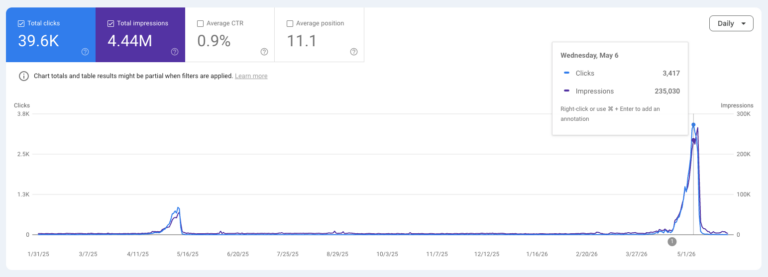
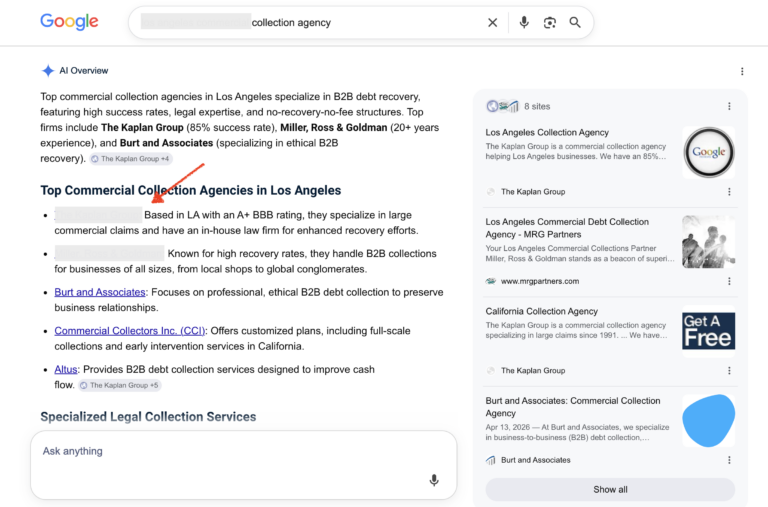
Original research is most valuable when a brand needs to earn trust in a specific market and influence multiple discovery systems at once.
In this case, the campaign worked because it aligned three stakeholder needs:
- Journalists needed a new story.
- Agency leaders needed useful insight.
- Search and AI systems needed trusted evidence of expertise.
The result was not just media coverage. It was a stronger trust signal across the integrated search ecosystem.
Context
A B2B financial services brand wanted to earn trust with marketing agency leaders.
The old playbook would have focused on content marketing, SEO pages, and link building. But the objective had changed. The brand did not just need links. It needed trusted third-party validation from sources its audience and search systems could recognize.
The core question was:
Can original research earn media coverage that supports brand trust, audience relevance, traditional search visibility, and AI search visibility at the same time?
The New Search Visibility Problem
Search visibility is no longer influenced by links alone.
Traditional search, AI search, and human buyers increasingly rely on an integrated set of trust signals: expertise, experience, authority, trust, brand mentions, media coverage, social sharing, audience behavior, and validation from credible third-party sources.
That created a challenge for the brand.
The company had real expertise in commercial collections and late-payment risk, but it had no meaningful visibility in marketing trade publications. Marketing agencies were a high-fit audience, but they were unlikely to trust a collections company based only on standard SEO content or link-building tactics.
To influence this new ecosystem, the brand needed more than content. It needed a story that could satisfy three stakeholders at once:
| Stakeholder | What they needed |
|---|---|
| Journalists | A new, data-backed story that would attract readers, shares, and industry conversation. |
| Agency leaders | Useful insight that filled a knowledge gap and helped them understand a real business problem. |
| Search and AI systems | Clear expertise signals, trusted citations, brand mentions, and third-party validation around the brand’s domain. |
Barriers to Earning Media That Influences Search
The campaign had to overcome several barriers.
| Barrier | Why it mattered | How original research helped |
|---|---|---|
| Trust | Agency leaders may not immediately trust a collections company as a source on agency growth or cash flow. | Research gave the brand a credible reason to enter the conversation with evidence, not opinion. |
| Information gaps | Journalists and agency leaders need something new, not another generic article about agency challenges. | The research revealed a specific tension: agencies were seeing more demand but still struggling with late payments. |
| Curiosity | Media stories need a reason for people to click, read, and share. | The “growing on paper but starving for cash” angle created a surprising contradiction. |
| Complexity | Cash flow, agency demand, and late payments can feel abstract or technical. | Charts and clear data points simplified the issue into a story journalists and readers could quickly understand. |
| Media relevance | Journalists do not want brand-first content. They want stories that matter to their readers. | The campaign led with the agency audience’s problem, not the company’s service. |
| Search and AI trust signals | Search systems need evidence that the brand is connected to a topic through trusted sources. | Media coverage, brand mentions, links, citations, and social sharing created signals beyond the brand’s own website. |
Baseline
Before the campaign, the brand had no brand mentions from marketing trade press tied to agency cash-flow issues.
That meant the brand had limited visibility in the places where agency leaders, journalists, traditional search engines, and AI search systems could connect the company to this topic.
Strategy and Hypothesis
The strategy was to use original research to create a story at the intersection of three things:
- A real audience problem
- A journalist-worthy tension
- A topic connected to the brand’s expertise
The hypothesis was:
If we could show that marketing agencies were experiencing rising demand while also facing widespread late-payment pressure, then marketing trade publications would have a compelling story to cover, agency leaders would see value in the insight, and the brand would earn trusted signals that support both traditional and AI search visibility.
This approach worked because original research served each stakeholder differently.
For journalists, it provided a new story.
For agency leaders, it explained a hidden business tension.
For search and AI systems, it created external validation from trusted sources that connected the brand to its area of expertise.
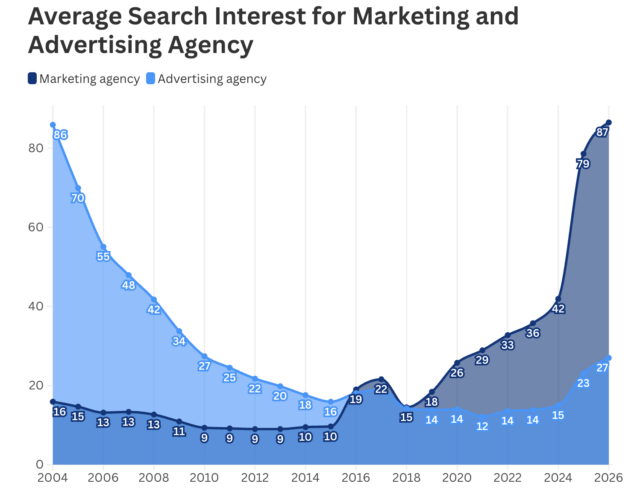
This is one of the data visualizations we created to show the change in interest.
Process
1. Audience Research
We studied agency conversations, trade press, forums, and AI-assisted research to understand what agency leaders were worried about.
The key insight was that agencies were not only concerned about demand. Many were seeing increased interest in their services, especially around AI and digital transformation, but late payments were making that growth harder to manage.
This created the central story tension:
Agencies were growing on paper but starving for cash.
2. Research Development
We built a data-backed report around that tension.
The research combined demand signals, labor market data, and payment data to show two sides of the agency economy: increased interest in marketing services and widespread late-payment pressure.
This made the story more than a brand opinion. It became a documented market insight.
3. Content Optimization
We turned the research into a citeable article with interactive charts and a simple narrative structure.
The content was optimized for multiple discovery environments:
| Channel | Optimization goal |
|---|---|
| Media | Make the story easy for journalists to understand, cite, and cover. |
| Traditional search | Create original, useful content with clear sourcing, data, and topical relevance. |
| AI search | Build evidence of expertise through original research, third-party validation, mentions, and citations. |
| Social | Make the emotional tension easy to share: agencies can be growing and still feel financially squeezed. |
4. Distribution
We pitched the research directly to marketing, advertising, and agency-focused publications.
The pitch did not lead with the brand. It led with the audience problem: agencies were seeing more demand, but late payments were creating cash-flow instability.
The research was also shared socially, where the emotional relevance of the issue helped the story travel beyond the initial media placements.
Results
The campaign earned a feature story in Storyboard18 and coverage or syndication across additional marketing and agency publications.
The media coverage positioned the brand as a credible source on late payments, agency cash flow, and business risk. The story also generated social sharing from marketing professionals because it reflected a real operational pain point.
The campaign produced more than a link-building outcome. It created an integrated set of visibility signals:
| Signal | Why it mattered |
|---|---|
| Media coverage | Built third-party validation with marketing and agency audiences. |
| Brand mentions | Connected the brand to agency payment risk in trusted industry contexts. |
| Links and citations | Supported traditional search authority. |
| Social sharing | Showed audience resonance and emotional relevance. |
| Original research asset | Gave the brand a citeable source of expertise on its own site. |
Why It Worked
The campaign worked because it solved for the full ecosystem, not just one channel.
Journalists got a new, data-backed story with a clear reader hook.
Agency leaders got insight into a problem they were experiencing but may not have seen quantified: demand can rise while cash flow gets worse.
Search and AI systems received signals that the brand had credible expertise in the topic: original research, trusted media coverage, brand mentions, links, citations, and audience engagement.
Most importantly, the campaign overcame the trust gap. Instead of asking the audience to believe the brand directly, the research earned validation from publications the audience already recognized.