
Build your site’s topical authority with digital PR (DPR), with links from local, national, and trade media.
Key Insights
I’ve spent a long time testing and analyzing campaigns that integrated digital PR and SEO. It’s a surprisingly simple but powerful way to earn links and brand mentions that have an impact on your site’s ability to rank.
Digital PR is a broad topic that many use to only refer to a link building tactic, but I’ve worked on PR campaigns for some of the world’s largest brands with both internal and PR communications firms, and DPR has the potential to influence audience behavior as well as search engine behavior.
Below, we’ll focus on how to use digital PR to secure links and brand mentions.
Digital PR (DPR) for SEO merges traditional public relations strategies with SEO objectives to boost organic visibility and influence user behavior on websites. It leverages the power of digital content and media relations to achieve measurable SEO gains.
The approach involves several strategic methods, including earning links and brand mentions through owned asset marketing, securing high-ranking thought leadership articles, and increasing brand search volume. By employing these techniques, businesses can enhance their topical authority and improve their online credibility and trustworthiness.
The company Valoir received a link to its homepage from ZD Net because it created a study and provided expert insights to the media.
You can secure these types of placements with the owned asset marketing (OAM) strategy, which this course teaches.
This type builds a site’s topical authority around a specific keyword segment or topic area.
Internal experts can secure thought leadership articles that rank well in search engines.
Numbers 1 & 3 in the screenshot are my articles for SEJ and SEL that rank for “Digital PR for SEO,” and 2 is an article from the Forbes Agency Council, which is a sponsored guest posting service from Forbes.
The other type of digital PR is to drive brand search volume with reviews, feature articles, resource lists, webinars, or podcasts that talk about the product or associate the product as being a solution to a problem.
DPR Type 1 is ideal for earning links and brand mentions.
The interest in digital PR for SEO is growing. The chart below is Google trends for “Digital PR SEO” over 8 years. Why?
Digital PR earns links from trusted sources with editorial discretion. Google is becoming better at evaluating a site’s credibility in a topical category.
Digital PR is different from link building. Digital PR builds links and brand mentions by pitching stories to journalists and providing them with the data and experts to guide the stroy creation.
Owned asset marketing (OAM) is a digital PR strategy that builds links and brand mentions by marketing owned assets to local, national and trade media: press and podcasts.
Trend analysis:
Identify trends related to your individual or company expertise. Select a keyword category to improve visibility and identify topics related to these trends in which you have expertise.
For example, Forbes discusses a growing interest in the US moving manufacturing to Mexico from China. This can have an impact on a lot of jobs and improve the stability of US supply chains.
Create a fast asset:
Find unique data that can be gathered quickly from publicly available data sources or crawling websites.
For the manufacturing example, I found a growing trend in Google Trends for the keyword “manufacturing in Mexico.” This unique data can help the journalist tell a story about the trend.
Then, find an internal expert who can provide insights into the impact this can have on the audience or solidify the importance of this data.
Market to journalist:
Create a storyline and make the data available for journalists and content creators.
Outbound pitching: to pitch to a journalist using a press release. The OAM method uses a simple structure to share data and insights that is easily scannable and gets to the point.
Inbound PR: Optimize content for SEO so that journalists or content creators can find it when researching articles. Create a blog article that explains the data.
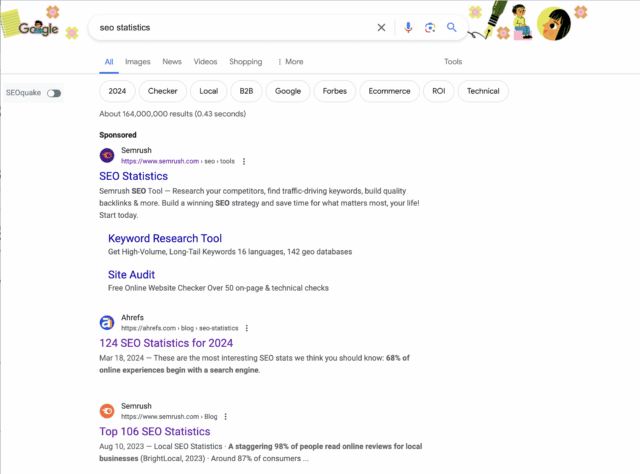
Content creators use keywords like “{industry} + statistics 2024” or “percentage of manufacturing companies outsourcing to Mexico” to find sources that they will then link to and source in their content.
One of my favorite examples is the keyword “SEO statistics,” where Ahrefs ranks an article with a list of statistics. This ranks in the top 3 of Google for this specific journalist keyword.
As a result of ranking, for this type of term, the page received links from over 3,100 referring domains. Huge win!
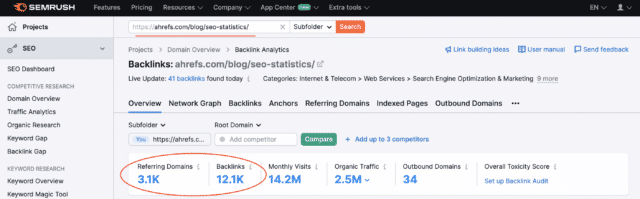
These links typically point to 1) the homepage, 2) a blog article about data, and 3) the expert’s bio page.
Leveraging Digital PR for SEO is an effective strategy to improve organic visibility by improving topical authority.
To effectively implement these strategies and achieve your SEO goals, consider these options.
You can either enroll in the Digital PR for SEO Mini MBA to gain the knowledge and skills to manage your campaigns.
Additionally, you can hire a digital PR for SEO agency like Purelinq to execute your digital PR strategy and maximize each campaign’s impact.
By choosing one of these paths, you can ensure you maximize the amount of links and mentions you earn from media.